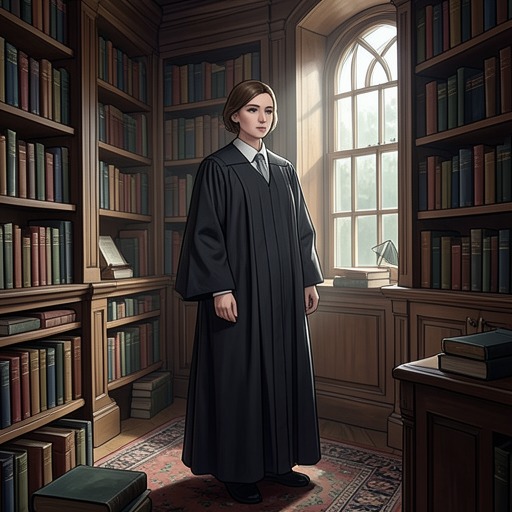
Redmond
Anne of the IslandRedmond is the college that carries Anne Shirley from the familiar world of Avonlea into a wider and initially unsettling life of study, competition, and new friendships. Its importance lies not only in the education Anne receives, but in the gradual change of scale it demands: she begins by feeling almost invisible among strangers and ends as a high-honors student whose old home and new life have become closely joined.
Arrival and the First Weeks
Anne and Priscilla register at Redmond after traveling there in the morning. With no further business that day, they leave the college crowds and take a walk at Old St. John's Cemetery. The campus has gathered freshmen and sophomores into conspicuous groups: new students cluster on the entrance-hall staircase, while sophomores look down on them. Familiar faces, including Gilbert Blythe and Charlie Sloane, are nowhere to be found. The scene makes Redmond feel not merely large but socially unfamiliar, a place where Anne cannot yet locate her own place.
Anne describes the registration crowd as making her feel like an insignificant speck. Priscilla’s discomfort is nearly the reverse: she feels conspicuously tall and awkward. Their different reactions sharpen the sense of disorientation, but they share a deeper difficulty. They had expected to continue at Redmond where life at Queen’s had left off, among people who knew them and in a community where they already belonged. Instead, the new college seems to have displaced the ground beneath them. Anne takes comfort in recognizing that this is the end of an earlier beginning, not proof that her prospects are over.
That first estrangement lasts for three weeks. Then classes, professors, students, and social activities begin to fit together as a coherent routine. The freshmen cease to feel like isolated individuals and acquire a class identity, complete with shared interests, rivalries, ambitions, and a class yell. Redmond’s annual Arts Rush gives this new solidarity a public test: after three years of sophomore victories, the freshmen win, in part through Gilbert’s strategic leadership and new tactics. The victory earns the class respect and gives its members a new confidence. Gilbert is elected freshman-class president and invited to join Lamba Theta, an unusual honor for a freshman. His initiation requires him to parade through Kingsport in a sunbonnet and a brightly flowered kitchen apron; he accepts the ordeal cheerfully, in contrast with Charlie, who says he could never submit to such humiliation.
Study, Opportunity, and Financial Pressure
Redmond’s academic life gives Anne room to excel. Her freshman studies prove manageable, helped by the sustained work she and Gilbert had done in Avonlea. Philippa Gordon also distinguishes herself, holding her own in every class and leading the women students except in English, where Anne surpasses her. Their success sits within a setting where at least one mathematics professor dislikes women students and had opposed their admission. Philippa’s performance against him makes academic ability visible within a college culture that is not uniformly welcoming.
The ease of Anne’s first year leaves time for the social life she enjoys, but it does not remove the economic conditions shaping her education. In her second term she resolves to win the Thorburn Scholarship in English. The award would allow her to return the following year without drawing on Marilla Cuthbert’s limited savings, something Anne is determined not to do. Gilbert is pursuing a scholarship as well. Later, Anne fears that she may not be able to continue: the scholarship available in her sophomore year is small, she will not take Marilla’s money, and she sees little prospect of earning enough during the summer. She considers returning to teaching at a district school until she can afford to finish. Redmond therefore represents both opportunity and a continuing financial vulnerability; staying enrolled requires more than academic promise.
A Homeward Connection and a New Social World
The letters from Avonlea change Anne’s sense of distance from Redmond. Before they arrive, her old life seems thousands of miles away. The first group contains six letters, from Jane Andrews, Ruby Gillis, Diana Barry, Marilla, Rachel Lynde, and Davy Keith. Their very different contents—Jane’s careful account of household matters and Ruby’s reports about her admirers among them—bring familiar people and concerns into Anne’s college routine. The correspondence links old and new lives closely enough that they no longer feel like separate existences. Redmond becomes easier to inhabit not because Avonlea has ceased to matter, but because Anne can carry its relationships with her.
Her friendships and activities also widen over time. By the second term she enjoys class rivalry, societies, social gatherings, and the deepening of new friendships. Gilbert frequently visits her at Thirty-eight, St. John’s, escorts her to most college affairs, and is associated with her in campus gossip. Anne resents the assumptions surrounding them but cannot simply cast aside an old friend. Her social independence thus develops alongside a relationship whose meaning she has not settled. After the summer, she returns as an experienced sophomore to greetings from a large circle that includes Priscilla, Stella Maynard, Philippa, Gilbert, and Charlie. Redmond’s changing class status is registered in the people who welcome her: she is no longer the stranger she had been at registration.
Later Years and Convocation
Redmond remains a setting for changing attachments as well as formal study. When Royal Gardner returns after spending two years in Europe, having completed his freshman and sophomore years at Redmond before leaving, he introduces himself to Anne through their shared college affiliation. Their encounter belongs to a more confident phase of her student life, in which she has a wider circle and a social identity extending beyond the friends she brought from Avonlea.
Near the end of her course, Anne and her friends recognize how quickly their Redmond years have passed. She remembers arriving with Priscilla as an isolated freshman and contrasts that beginning with their present status as seniors facing final examinations. The results confirm the work each has done: Anne earns High Honors in English, Priscilla takes Honors in Classics, Philippa in Mathematics, and Stella receives a good all-round showing. At Convocation, Anne must choose between the flowers sent by Royal and lilies-of-the-valley sent by Gilbert. She puts Gilbert’s flowers in place of Royal’s, although she cannot explain the choice to herself. Their association with Avonlea’s earlier days makes the gesture a convergence of the college present with memories and relationships formed before Redmond.
Narrative Significance
Redmond’s arc is measured by a shift in belonging. At first, its crowds make Anne feel unseen, and the scale of the college exposes how much she depended on the familiar community of Queen’s and Avonlea. Class identity, academic work, letters from home, and friendships gradually give the new place structure. The college does not replace home; it becomes livable as Anne’s old ties and new experiences begin to connect.
The setting also makes independence concrete. Anne’s academic distinction and her pursuit of the Thorburn Scholarship are bound to the practical question of whether she can afford to continue. Her progress is therefore neither simply a triumph of talent nor a seamless passage into adulthood: it requires work, financial calculation, and an evolving network of support. By Convocation, Redmond has taken her from an uncertain registration line to recognized achievement, while leaving her personal future open to choices that academic success alone cannot decide.